
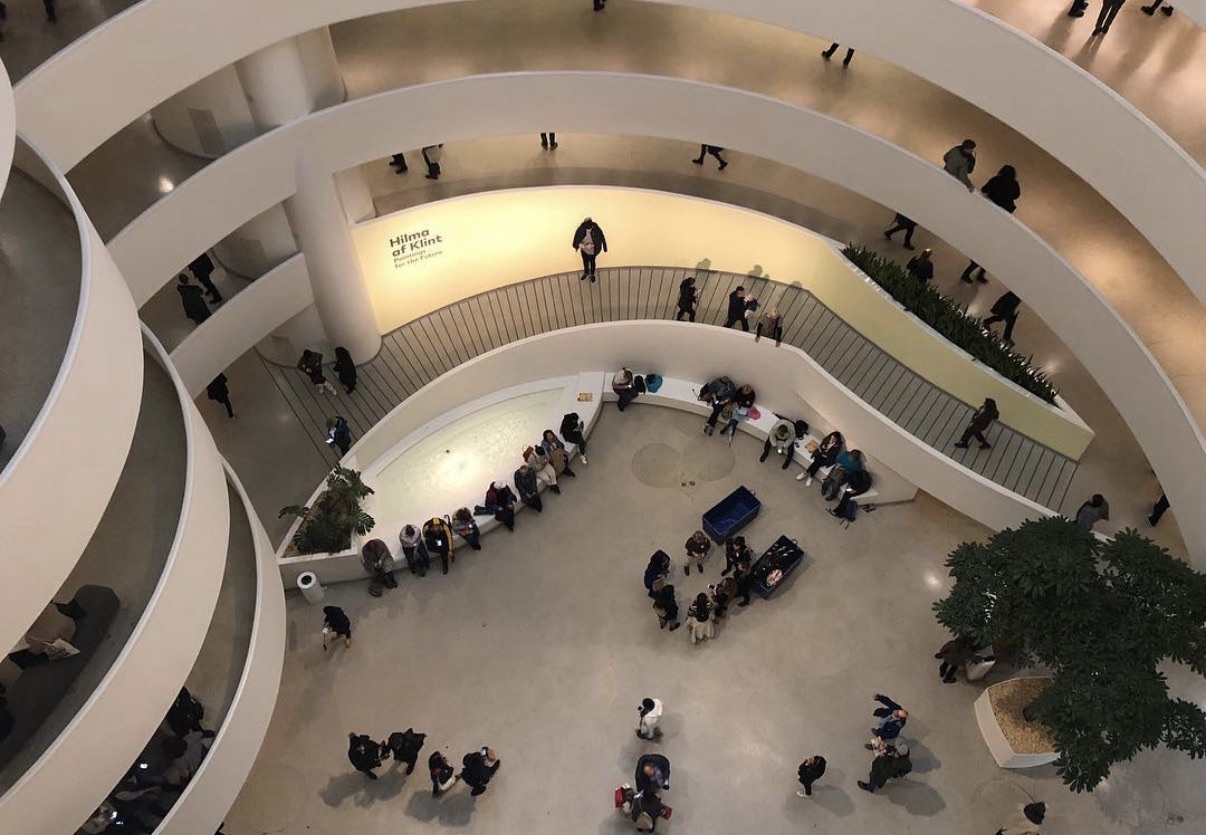
Solomon R. Guggenheim Museum, 1071 Fifth Avenue, New York – NY (USA)
TWhen the Swedish artist Hilma af Klint died in 1944, she left behind more than a thousand paintings and works on paper she had kept largely private during her lifetime. She believed the world was not yet ready for them, and stipulated they remain unseen for another twenty years after her death. She was wrong about the timeline — it took considerably longer than that — but not about the gap.

af Klint was working in radical abstraction years before Kandinsky, Mondrian, or Malevich arrived at similar territory. She was doing it in private, without institutional recognition, without a critical framework that would have given her work a name. The Guggenheim’s Paintings for the Future — her first major solo exhibition in the United States — was, among other things, a belated correction. Whether corrections this late count as justice is a question the exhibition itself could not answer.
The building helped. Frank Lloyd Wright’s spiral rotunda — the continuous ramp coiling upward from a central atrium — turned out to be an uncanny fit for af Klint’s own unrealised vision: she had left behind plans for a spiral-shaped temple in which to display her work. She never built it. The Guggenheim, without knowing it, built it for her. Moving through the exhibition meant moving through that spiral, the permanent collection’s Kandinskys and Picassos visible in passing. And then the paintings arrived.

The Ten Largest occupied its own space. Monumental in scale, boldly coloured, each canvas mapping a stage of human life from childhood through old age. Walking through them in sequence, I found myself slowing down. Not because they demanded it. Because they earned it. You read your own life into the progression without deciding to.
The Temple series operated at a different frequency — more cosmic, more concerned with the invisible structures that af Klint believed lay beneath the visible world. She was deeply engaged with spiritualism and theosophy, and the Temple works show it: geometric forms, symbolic motifs, the feeling of something being mapped that cannot be seen directly. Whether you share those beliefs or not, the conviction in the work is unmistakable.
The exhibition became the most visited in the Guggenheim’s history. af Klint had painted for the future. The future, it turned out, was paying attention — just not in the way she imagined, or when she expected.
The canon is not fixed. It is simply what has been visible so far.
Artène covered Hilma af Klint: Paintings for the Future, November 2018. All photography by Elasse.