
Galleria Michela Rizzo, Isola della Giudecca 800/Q, Venice (Italy)
The day before had been warm and sunny. By morning the sky had closed and the rain was steady off the lagoon. There was a puddle directly in front of the gallery door — a momentary gibigiane, the light breaking on the surface before you even stepped inside.
Galleria Michela Rizzo sits on the Isola della Giudecca, a vaporetto stop across from the Zattere. From the outside the building reads as industrial — no plate glass, nothing that announces itself. You ring a bell to get in.
Gibigiane — the Venetian word for the glimmer of light reflected on water or a mirror — was Brian Eno’s third solo exhibition at the gallery. The works inside produced their own version of that effect: light that shifts continuously, colour that never arrives at a final state.

The ground floor opened with a series of silkscreens on velvet lining the entrance, before moving into a dedicated dark room housing three lightboxes — Field II, Umbria II, and River. Each presents a slowly shifting field of colour, the transitions so gradual you adjust to them without noticing. Eno’s method is one of overlapping unsynchronised cycles: several independent light sequences running simultaneously, producing combinations that never exactly repeat. Elsewhere on the ground floor, three tapestries woven by Giovanni Bonotto from drawings Eno made on a computer in the early 1990s using software designed for children. The imagery reads as digital — grids of small squares, colour relationships flat and precise. Two in reddish tones hung on the side walls; a third in white and green faced them. In the corner beside one of the reddish tapestries stood Filipendula — a ceramic vase on steel, its flower-shaped forms concealing speakers, sound coming from it at low volume.
The first floor was where the visit found its centre.
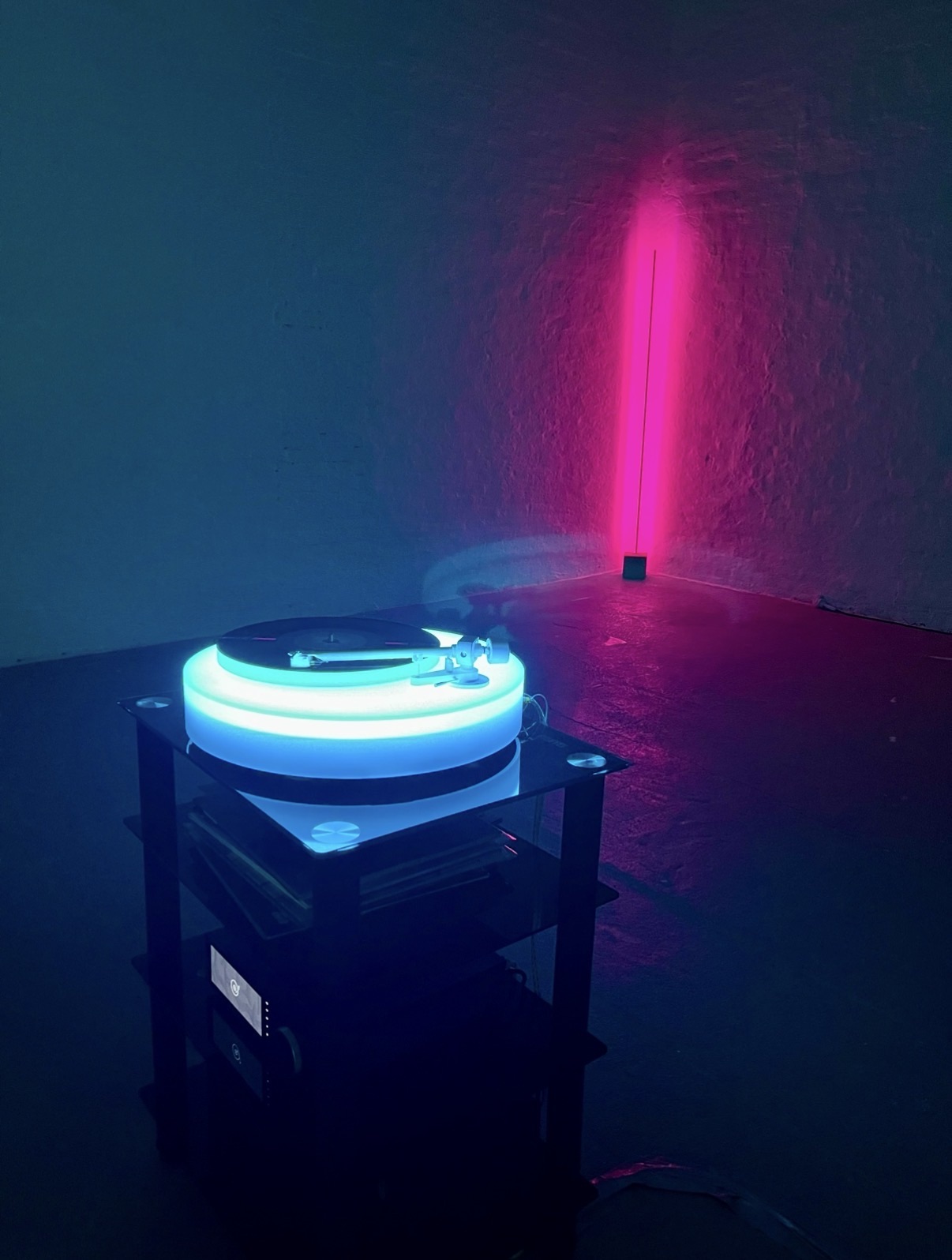
Still and Ovation — two LED light strips set in cement, nearly two metres tall — stood at opposite corners of the room. Turntable II occupied the space between them. The work is built from acrylic and LED lights — platter and base each cycling independently through generative sequences of pink, blue, orange, and green, the shifts programmed to occur randomly and slowly. Limited to 150 units worldwide, each signed and numbered by Eno, it functions simultaneously as a record player and a light sculpture. As Eno has written: “When it doesn’t have to do anything in particular, like play a record, it is a sculpture.”
One of Eno’s own records was playing when I entered. I sat on the bench, two metres in front of it. The room was empty. The turntable’s light and the music ran on entirely separate tracks, programmed with no knowledge of each other. And yet they moved together — not in unison, but in the way that two slow things moving in the same dark room will start to feel like one. I stayed for the full side of the LP — not because I decided to, but because leaving would have required a reason, and the room gave me none.
On a rainy day in Venice, arriving through puddles to ring a gallery bell, gibigiane was the right word for what was inside.
Artène covered Brian Eno “Gibigiane”, May 2024.