
PinchukArtCentre at Palazzo Contarini Polignac, Dorsoduro 874, Venice (Italy)

I came to Palazzo Contarini Polignac by boat from the Giardini — docked near the Accademia, three minutes on foot. The palazzo is in Dorsoduro, next to the Accademia bridge, and from the street gives little away. You enter through a reception room that is almost entirely empty and cross it to the far end, where a narrow courtyard opens up. Tucked into the corner of the corridor, next to the entrance to the main room, Ryan Gander had placed a large black ball. On its surface, in plain text: Can you measure time another way? It sat there in the shadow without pushing the question further.
The main ground floor room was Simone Post’s. She Knew She/It/They Would Melt had filled it with more than ten candy chandeliers — not hung at ceiling height but lower, most of them at head level or below, all of them lit, casting a warm glow across the space. Lollipops framed as family portraits. Sugar formations where antique fixtures would have sat. As a girl, this room would have been a dream made physical. It was also fragile in ways that made that clear during the opening: a visitor moved too close and a section of one chandelier’s arm broke off. Later, passing through again, it had been repaired — Post, I assumed, quietly restoring what the evening had taken. The work could survive contact, just barely, and that seemed to be part of what it was saying.

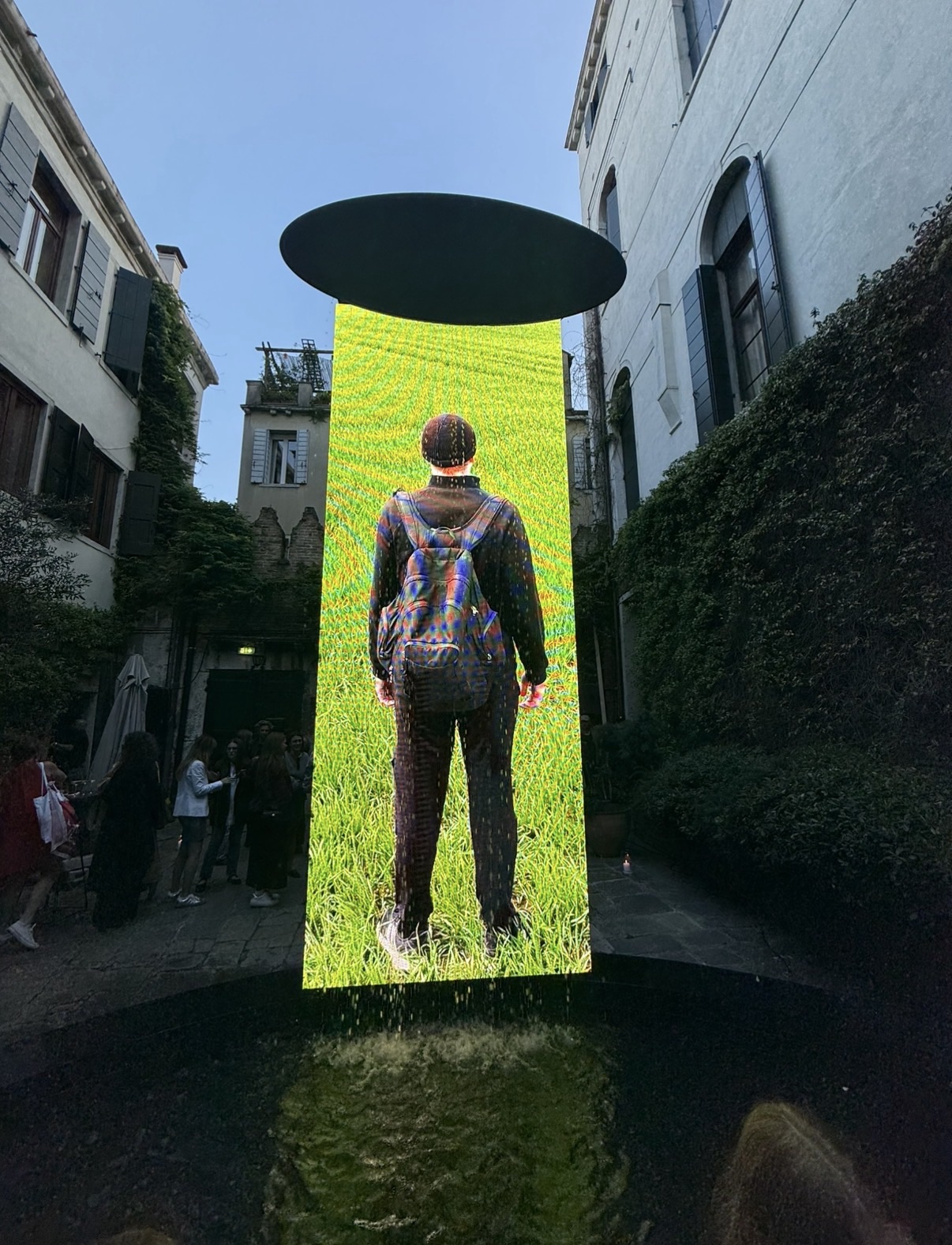
From that room you could step directly onto a small dock onto the Grand Canal, the water right there. On the opposite side, through the main room, a courtyard where prosecco and food were circulating. At its centre, Lesia Vasylchenko’s 1534 — a video and fountain installation over two and a half metres tall, placed in front of the existing courtyard fountain. On a LED screen, nearly static imagery of a young man in a liminal landscape; in front of it, moving water, the sound of rain falling into stone. The number in the title changes daily: the days of youth that Vasylchenko’s best friend Yurii has given to the war since February 2022. The water keeps moving. He doesn’t.

The opening speech was scheduled for the top floor. The top floor was impassable — the crowd had filled every room going up. I made my way back down and followed through a video screen on the ground floor set up for exactly this reason. One of the artists whose work was upstairs made the same calculation and went to the courtyard for a glass of wine instead. Victor Pinchuk opened: Ukraine’s resilience, art’s role in difficult times. Tetyana Berezhna, Ukraine’s Deputy Prime Minister and Minister of Culture, followed. Then the curators Björn Geldhof and Oleksandra Pogrebnyak. Hlib Stryzhko — marine, veteran, former prisoner of war, the man whose testimonies gathered from other combat survivors are printed across the palazzo’s rooms on glistening pink scrolls by artist Bohdana Kosmina — and Yuliia “Phobia,” senior sergeant and combat medic in the Armed Forces of Ukraine, both appeared in military fatigues. What Hlib said that stayed: while severely wounded after an attack, someone gave him a sweet. That taste was enough to produce joy. One sentence that held the whole exhibition’s premise more precisely than any curatorial statement could. The speeches ended with a pianist at a grand piano that had been set up on the top floor for the occasion, closing the ceremony with classical music — the sound drifting down through the floors.
On the first floor, Ashfika Rahman’s Than Para — No Land Without Us stopped me. From across the room it read as a large gold sphere. Getting closer, the sphere resolved into thousands of small Hindu temple bells on golden silk threads — each one catching the light differently, each one capable of sound. Touching it was permitted; you could move a hand through gently and the bells shifted, a slow shimmer passing outward. Far and near were two entirely different works.
Still Joy runs across three floors and holds far more than one crowded evening can take in — rooms of video work that need time and quiet that an opening night doesn’t have. It runs until 1st August. The exhibition’s premise sounds large — joy as radical act, joy as survival — but what it actually produces is specific and quiet: a soldier’s memory of a sweet, bells that move when you touch them, chandeliers at eye level rather than above you. The scale is the point.
Artène covered the opening of Still Joy — From Ukraine into the World, a 61st Venice Biennale Collateral Event, 7 May 2026. All photography by Elasse.
Further audiovisual content at instagram.com/elass | The exhibition runs till 1 August. Admission Free.