
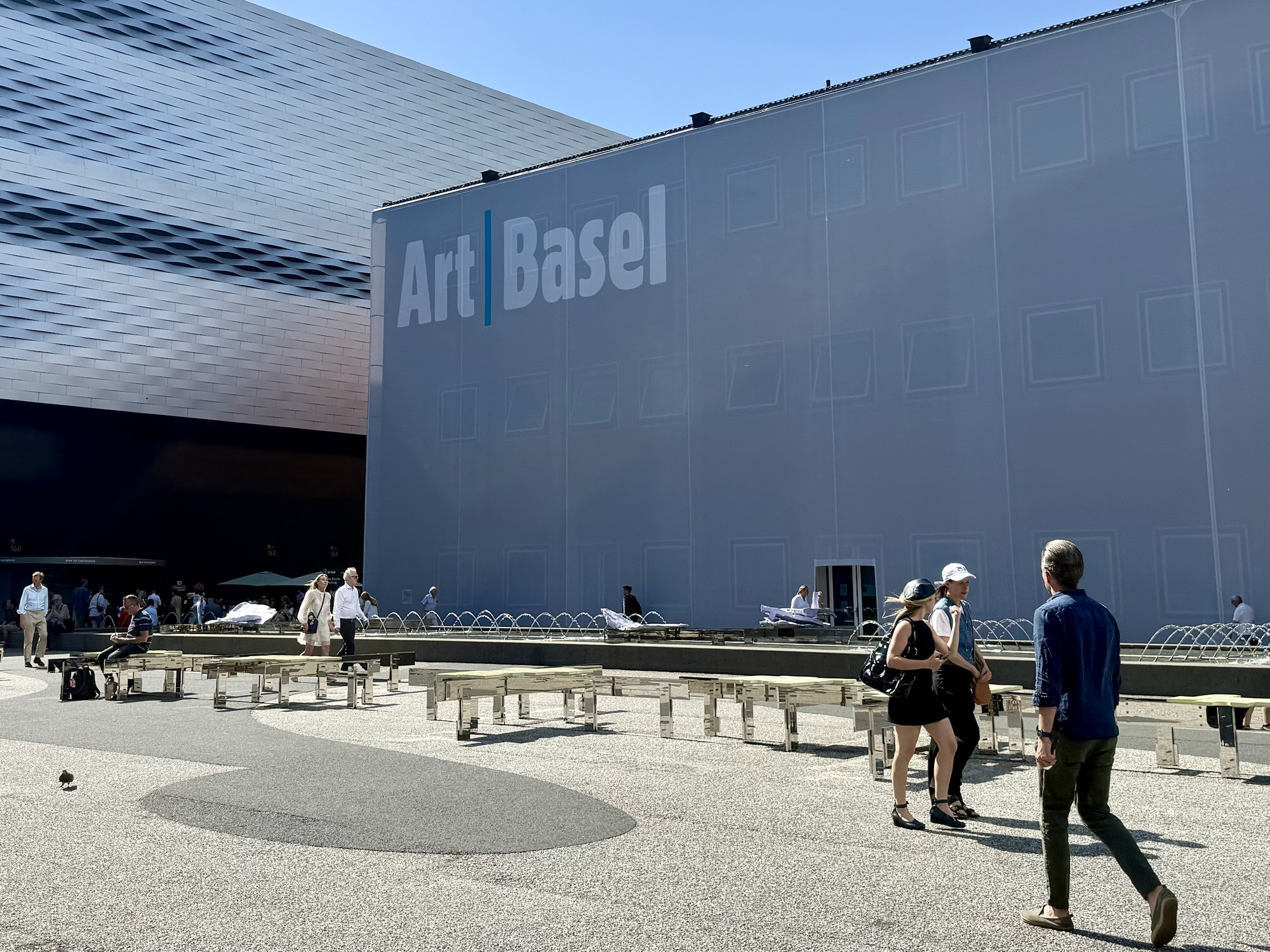
Messe Basel – Hall II, Messeplatz 10, Basel (Switzerland)
The train had problems. By the time I arrived in Basel on Wednesday afternoon, the fair was already a day old and the first twenty-four hours of coverage — the VIP preview, the early sales, the opening-day crowd — had run without me. Thursday was the first day open to the public, and it showed. The queue for security in the heat outside Messe Basel was long, the crowd inside dense, and the atmosphere immediately commercial.

Art Basel brings together 290 galleries from 43 countries. Walking in from the right side of Hall 2, moving through the ground floor in a wide arc toward the major booths, what hits first is the sheer accumulation — booth after booth of significant work, galleries representing artists whose names carry decades of institutional history. The scope is genuinely impressive. Forgetting the context it sits in is harder.
The exception was Perrotin, which takes one of the most impressive multi-level spaces in the fair — two floors, corner position, room to breathe. Murakami’s Flower Parent and Child dominated the upper level, the colours hitting you from across the hall. Below, a work from JR’s Les Esquisses de la Caverne series (2026) — a preparatory sketch for his simultaneous transformation of the Pont-Neuf in Paris into a cave of printed fabric, running that same week. Photography, drawing, and collage assembled on crumpled zinc sheets salvaged from Parisian rooftops, cave forms drawn over a grey cityscape. Two projects running in parallel in two cities. The booth had a momentum to it that most others didn’t.

At Sprüth Magers, Andreas Gursky’s Kreuzfahrt (Cruise) (2020) — a monumental photograph of a cruise ship under construction, the hull reduced to a vast grid of identical windows, hundreds of them, each one a frame within a frame. The kind of image you could stand in front of for a long time, tracing the detail, following the grid until it becomes something else. I had about a minute before the crowd closed in around it.
Barbara Kruger’s Untitled (Thwart the Law) (1987), Arthur Jafa’s Black Difference, Miles and Betty (2024), Jenny Holzer’s Truisms — Push yourself to the limit — appeared across different booths. Holzer I had seen before, at the Tate and at the Peggy Guggenheim in Venice; encountering her text works at a fair is a different experience, the urgency of the language slightly at odds with the transaction happening three feet away.

Conrad Shawcross’s Time Pebble (11 IS:S6) (2026) at Victoria Miro stopped me. An oval concave dish composed of nested hexagonal stainless steel panels — the form traces back to Shawcross’s visit to the Holmdel radio telescope, the instrument used to detect the first evidence of the Big Bang’s cosmic afterglow. At 112 × 90 × 52 cm, it sits on a plinth and pulls light into its centre. You spend longer with it than you planned to.
Juan Muñoz’s Three Laughing at One (2000) at Elvira González — I had seen his work years before in Spain, and the figures still carry the same unsettling animation, the laughter directed at something just outside your field of vision. Thomas Schütte’s Old Friend Revisited at Peter Freeman was small, quietly authoritative. Georg Baselitz at White Cube showed A Torn Dog Upwards — different from the inverted figures you expect from him, rawer, less iconic, harder to place at first glance.
At Thaddaeus Ropac: Warhol’s Statue of Liberty and Alex Katz’s Larry No. 1 in the same space. David Hockney’s Delphiniums on My Garden Table appeared somewhere on the ground floor — Hockney had died ten days before the fair opened, at eighty-eight. The flowers in the painting looked the same as they would have looked a month ago. Elsewhere in the fair, two of his works sold for millions within the first days. The market does not pause.
At the centre of Hall 2, a full-height courtyard opens up — a staircase, a balcony running around it, tables and chairs beneath, a few trees. People were sitting with coffees, taking a break from the booths. I did too — an iced tea and a piece of cake, the fair noise falling away for a few minutes. Then I went back in.
Artène covered Art Basel 2026, 18 June 2026. All photography by Elasse.
Further audiovisual content at instagram.com/elass