
DAG — Digital Art Gallery, Galleria Bombi, via Giorgio Bombi 7, Gorizia (Italy)
From Piazza della Vittoria you walk down into the hill. Nothing prepares you for what’s inside.
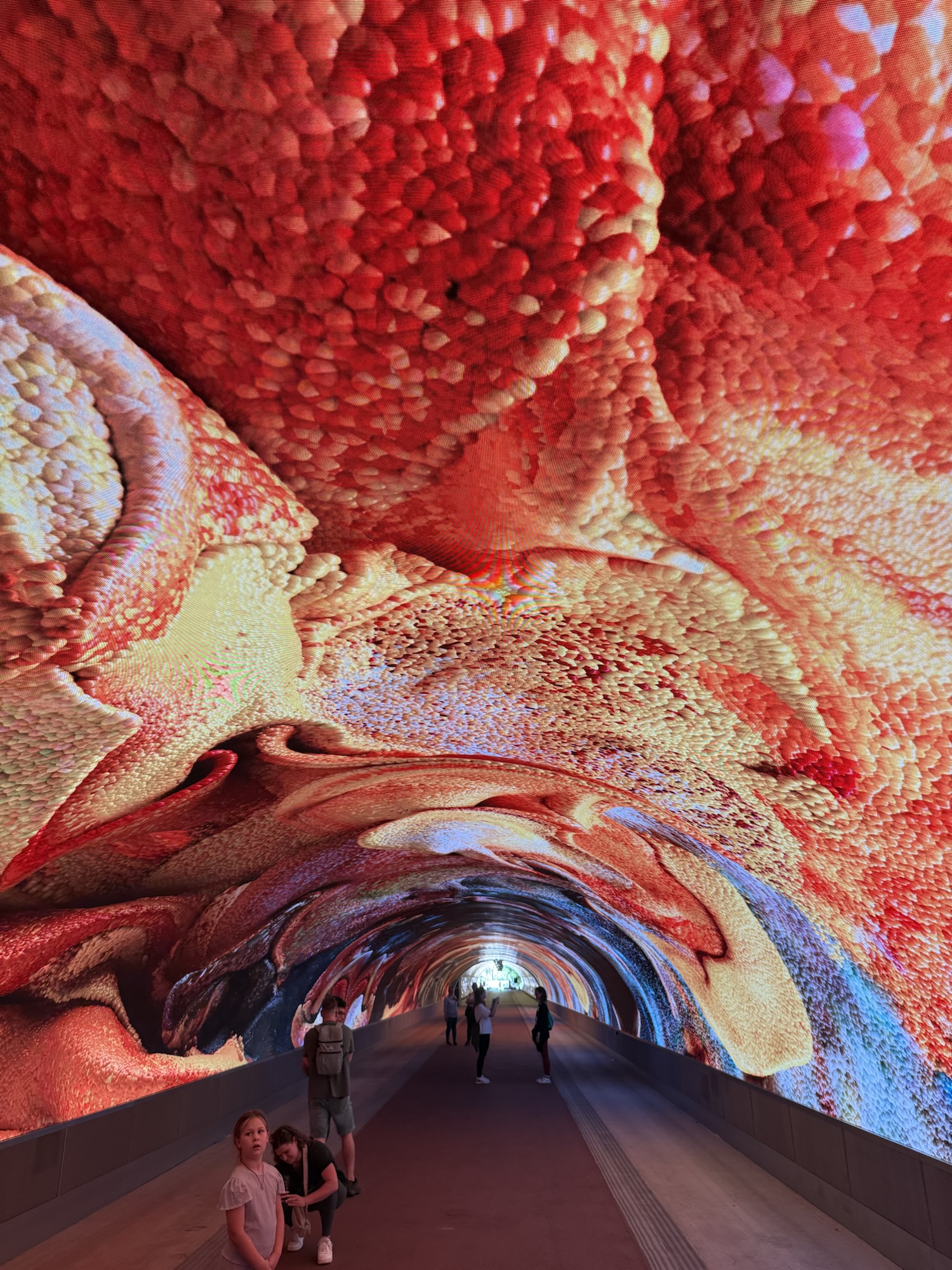
The Galleria Bombi runs for over 300 metres under the castle hill of Gorizia, a border city in Friuli Venezia Giulia that spent most of the twentieth century divided — first by war, then by the Iron Curtain, the Slovenian half becoming Nova Gorica on the other side of a closed frontier. The tunnel served as an air-raid shelter during the war, then as a pedestrian shortcut, then as nothing much at all for a long time. Last December, the central 100 metres reopened as the DAG — Digital Art Gallery, fitted with a curved LED structure covering approximately 1,000 square metres of digital surface. The inaugural work is Data Tunnel by Refik Anadol, made specifically for this space, and it runs through December 2026.

Anadol I already knew — his MoMA commission had circulated widely, and his studio’s work in Los Angeles was hard to miss if you followed the digital art circuit. His practice runs large environmental datasets through AI-trained generative systems — for Data Tunnel specifically, a Large Nature Model trained on millions of images drawn from ecosystems across the planet, translating that data into a continuous visual flow. The intention, as he has described it, is something close to a natural dream: nature rendered as data, data rendered as something you can stand inside. What comes out is usually spectacular. Here, the space keeps up with it.
I arrived around 5pm on a warm afternoon. The sun was still high. You book a free ticket online, scan a QR code at the turnstile — two staff in attendance — and walk into roughly 100 metres of plain tunnel before the screens begin. There are no doors. You can still see daylight at both ends throughout, a lit exit somewhere ahead of you the whole time. That helps.

The temperature drops noticeably once you’re inside — welcome on a hot afternoon. The panels wrap the ceiling and descend to about half a metre above the pavement on both sides; the floor itself is reddish and marked off, a metre from each wall, keeping visitors to the central walkway. A staff member paced the restricted edge throughout, a reminder that someone had to actually build all this.
Data Tunnel runs in three sequences — botanical forms, open water, atmospheric light — with colour as the signal for each shift. Within each sequence the images constantly morph, forms dissolving into one another in a continuous flow. Between sequences: a few seconds of black, then a brief transition of compressed flowers covering every surface before the next one opens. The sound is ambient — birds, seagulls somewhere underneath, relaxing without being anodyne. It fills the space and stays there.

The overall effect is of fluid — small bubbles dissolving and flowing across the curved surfaces above you. The palette shifted green at one point and it looked like snakeskin. I stopped tracking time without noticing. The thirty minutes I spent inside only registered when I checked my phone on the way out.
About thirty visitors were inside when I was there, most standing in one spot, turning slowly, phones held up. A few were walking. I moved to the far end, stood for a while, came back. At one point a young man walked straight through at a brisk pace, eyes forward. A few minutes later, an elderly woman did the same, heading to the other side of the hill. Neither looked up. I realised they were probably just crossing town. A city is still a city, even when someone has installed 148 million pixels in the middle of it.
Exiting, you re-enter the plain tunnel gradually. By the time you reach the turnstile on the far side you’re back in afternoon light. Surfacing.
Anadol designed the work for this specific space, this specific city. You enter a former air-raid shelter and come out the other side having been somewhere that felt like a dream.
Artène covered Refik Anadol: Data Tunnel , 4 June 2026. All photography by Elasse.
The installation runs through December 2026 — further audiovisual content at instagram.com/elass . Free tickets at dag.gorizia.it.
Leave a Reply