
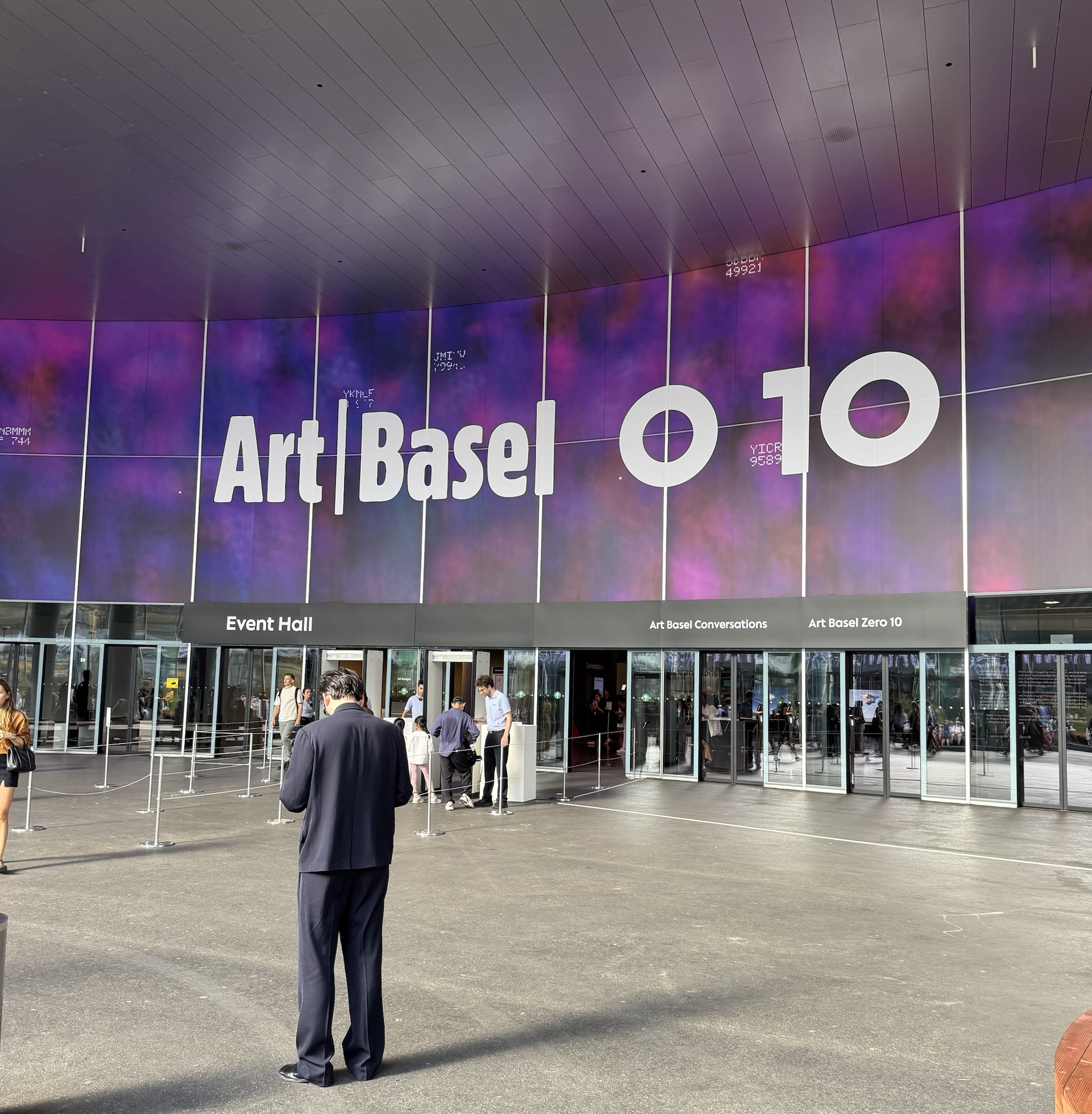
Messe Basel – Event hall, Messeplatz 10, Basel (Switzerland)
In 1915, Kazimir Malevich showed Black Square in the corner of a Petrograd gallery where a Russian Orthodox household would hang an icon. The exhibition was called 0,10 — zero for the destruction of the old world, ten for the artists originally planned to participate. Art Basel’s new digital platform takes its name from that show, and the reference is intentional. Zero10 is a claim about where art is going next.

The Basel edition occupies the Event Hall on Messeplatz, directly across from the main fair — a large open space with high ceilings, no booths, works distributed around the room. It feels closer to a group exhibition than a fair sector, and the crowd reflects that: younger, less transactional, moving differently than the galleries across the square.
The first thing you see on entering is John Gerrard’s triptych, presented by Fellowship: Western Flag (Spindletop, Texas)(2017), Flare (Oceania) (2022), and STANDARD (2023), shown together for the first time. Three real-time simulations — wind, smoke, fire — generated continuously through custom software, each centred on fossil fuel extraction, environmental collapse, systems of power. Nothing about them is subtle, and that is the point. In a week when geopolitics saturates every conversation, these works feel less like commentary than plain description.
Further in, I stopped at a piece on the floor — Nguyen Wahed, Andreas Gysin, and Leander Herzog. One of the assistants came over and explained how it was built, constructed from data. There is something particular about that kind of explanation in person: not a wall text directing interpretation, but someone describing a process. The work looked calm. What was generating it was considerably more complex.

Memo Akten and Katie Peyton Hofstadter’s Boundaries (2024) was showing in a smaller version than I had seen before. The original was commissioned for the 60th Venice Biennale, installed in the Chiesa di Santa Maria della Visitazione — a monumental piece in a 16th-century church. Here the scale was reduced, but the work’s logic held: the boundary between body and environment made unstable, the self dissolving outward. Seeing it again at a different scale, you notice things the larger version absorbed.

Rafael Lozano-Hemmer, Black Hole
Andreas Gursky’s Ocean V stood as a large rectangular photograph — you register the size before the image, before the name. The surface reads as near-abstract at a distance, then gradually resolves into the Pacific. Gursky has spent decades working with elevated perspectives and the logic of the image at scale; Ocean V sits in that lineage. Placed here inside a digital art platform rather than a gallery booth, it reads as data as much as photography.
William Mapan’s piece, presented with Art Blocks, was drawing while I watched. A robotic system executing instructions set by the artist, producing lines in real time — finished drawings hung alongside it on the wall. Watching a machine draw is its own kind of experience: unhurried, exact, indifferent to being observed. The finished drawings on the wall show you where the process ends up. The robot in front of you shows you it hasn’t yet.
The Lozano-Hemmer presentation, Panoptic Chiasma, was where I spent the most time. Showing at Max Estrella and Bitforms Gallery, four works gathered under a single premise: computation as perception. I stepped deliberately in front of Black Hole (2026) — a spiral parabolic reflector with a panoptic camera at its centre, extracting facial features in real time. What it returns to you is not a reflection but an erasure: you watch yourself disappear. It takes a moment to step back.
Directly behind it, Spectral Subjects (2024) mapped body heat through a thermographic camera positioned in front of the monitor — your own heat signature rendered visible on screen, mixed with the residual warmth of people who had stood there before you. An assistant explained: the images are not recorded, identities obscured, what remains is heat and its dissipation. Two works, side by side, both turning a camera on the body, reaching completely different places.
Zero10 is free with registration and runs three days. You leave having seen things that were, in some sense, watching you back.
Artène covered Zero10 at Art Basel 2026, 17 June 2026 · All photography by Elasse.
Further audiovisual content at instagram.com/elass
Leave a Reply